The Mary Rose
| View previous topic :: View next topic |
| Author |
Message |
Salty Dog
Sailing Master
Posts: 10063

192187 Gold -
         more... |
 Posted: Sun May 03, 2020 5:37 pm Post subject: The Mary Rose |
 |
|
The Mary Rose and the birth of the Royal Navy
Henry VIII was an enthusiastic shipbuilder, whose pride in his “Army by Sea” would see his fleet grow from 5 at the start of his reign to 58 by the time of his death in 1547. While he may have had many ships, it is the Mary Rose that is remembered as his favourite. Notably, the life of the Mary Rose coincides almost exactly with the reign of Henry VIII.
Before the development of a standing Navy, English kings relied upon requisitioning merchant vessels in times of need. This was certainly cheaper than building, maintaining and manning ships in times of peace, but it was inefficient and difficult to mobilize. With the threat of Scotland to the north and France to the south, Henry VIII began to build his Navy as soon as he came to the throne.
 [/img] |
|
| Back to top |
|
 |
Salty Dog
Sailing Master
Posts: 10063
192187 Gold -
more...
|
| Posted: Sun May 03, 2020 5:38 pm Post subject: |
|
|
The Mary Rose and the Peter Pomegranate
The earliest reference to the Mary Rose is 29th January 1510, in a letter ordering the construction of “two new ships”. These ships were to be the Mary Rose and her sister ship, the Peter Pomegranate. The ships were built in Portsmouth, making the sinking of the Mary Rose in the Solent and her eventual resting place in Portsmouth’s Mary Rose Museum all the more poignant.
The first account that names the Mary Rose is a letter from June 1511. It is often claimed that the ship was named after Henry’s sister, Mary Tudor but no evidence supports this. Instead, it was the fashion to name ships for saints and the pairing of the Mary with the Peter supports this. The badges of the ships – the Rose and the Pomegranate – celebrate the royal couple; the rose being the symbol of the king, and the pomegranate being that of his first wife, Katherine of Aragon. Neatly, the Virgin Mary was known at the time as the ‘Mystic Rose’; the name of the Mary Rose therefore signifies not only the power of the Tudor dynasty, but also that of the Virgin Mary.
The Mary Rose was larger than her sister ship - 600 tons to the Peter Pomegranate’s 450 - but this was not the only difference between the ships. While both were carracks designed for war, the Peter Pomegranate was not built to carry heavy guns. The Mary Rose, on the other hand, carried six or eight large guns from the beginning of her career. This required a new design feature: gunports. The Mary Rose was therefore of a state-of-the-art design. It has been suggested that Henry himself insisted on the design, which would add to the reasons why he was so proud of the Mary Rose. |
|
| Back to top |
|
|
Salty Dog
Sailing Master
Posts: 10063
192187 Gold -
more...
|
| Posted: Sun May 03, 2020 5:40 pm Post subject: |
|
|
Six months after the launch of the Mary Rose, Henry VIII was at war with France; the nineteen year old king wanted to show his mettle against the might of France. Against the advice of his father’s old advisers, Henry VIII declared war in 1512.
The Battle of St Mathieu
While the Mary Rose was not the largest of Henry’s ships – the 1000 ton Regent held that position – it was the Mary Rose that the Admiral of the Fleet, Edward Howard, picked as his flagship. This was to be a matter of significance in the Battle of St Mathieu on the 10th August 1512.
In the weeks leading up to the battle, Howard led successful raids along the coast of Brittany, capturing 40 French ships and sacking French towns. He returned to Portsmouth in late July in order to resupply where he was visited by the king. On the 6th August, Howard received word that the French navy had mobilized and he left Portsmouth to return to Brittany.
The French did not expect the English to arrive for several more days and were celebrating the Feast of St Lawrence when the English fleet arrived. Many French officers were celebrating the saint’s day on land, while local dignitaries and their families were feasting aboard the fleet. Upon seeing the English fleet, the large majority of the French ships fled, their retreat guarded by the French flagship, the Grand Louise, and the Cordelière.
The Mary Rose drew first blood; she shot out the mainmasts of the Grand Louise, killing 300 men and taking the ship out of commission. This short engagement marks the first instance of ships fitted with gunports engaging each other at range without an attempt of boarding, a watershed moment in naval history.
Despite this historic action, the most dramatic action of the day did not include the Mary Rose. While the Mary Rose was engaged with the Grand Louise, the 1000 ton English Regent grappled with the Cordelière. As with many of the French ships, the Cordelière was hosting families as the English fleet arrived and her captain, Hervé de Porzmoguer, made the hard decision to fight with civilians on board. As the ships grappled with one another, there was a suddenexplosion aboard the Cordelière. The flames spread to the Regent and both ships went down. Over 1500 people died from the two ships, including women and children aboard the Cordelière.
Much is made of the Mary Rose’s last battle, but you rarely hear about her first, the Battle of Saint-Mathieu, 33 years earlier.
Europe, 1512; The War of the League of Cambrai was waging. Although this was mostly an Italian war, all the European Countries were taking sides, and at this point England had allied itself with Spain, the Papal states and the Holy Roman Empire against an old foe: France.
At the start of the war, Henry VIII had appointed Sir Edward Howard as Admiral of the newly enlarged English Fleet, and allowed him to choose a flagship. Howard chose not to take the largest ship available, the Regent, but a smaller, newly completed ship. This ship was the Mary Rose. |
|
| Back to top |
|
|
Salty Dog
Sailing Master
Posts: 10063
192187 Gold -
more...
|
| Posted: Sun May 03, 2020 5:43 pm Post subject: |
|
|
Setting sail in April, Howard found that there was little to do with his new fleet. The French had yet to launch any warships, so they spent most of the summer harassing any foreign-looking ships that might appear, whether they be friend or foe, with the occasional escort duty and raids on towns along the French coast.

In early August 1512 news reached Howard, moored in Portsmouth, that the French had assembled a fleet at Brest. Howard set off shortly after, and engaged the enemy on 10th August in Berthaume Bay, near Brest. This caught the French fleet unprepared – indeed when the English arrived, they were partying, celebrating the feast of St Lawrence with the local gentry and their families.
Having ‘pooped’ the French party, the English Fleet engaged the French fleet. At the time the standard practise in sea battles was to avoid being closed in, keep your fleet together and hope the enemy run out of supplies before you do. Howard had a revolutionary new plan; shoot at the enemy a lot until they surrender.
The English and French fleets were similar in size; 25 ships the English Fleet, including the large Regent and Sovereign, as well as the brand new Mary Rose, while the French fleet had 21 ships, their largest ships, Grand Louise and Cordelière being slightly smaller than their counterparts, but overall the French had more guns.
It was the Mary Rose that, according to records, drew first blood, when she shot off the main mast of the French flagship Grand Louise, commanded by Admiral René de Clermont. Although the Grand Louise was able to escape, with the loss of 300 men, this marked the first time in the history of Naval warfare that ships with lidded gunports had engaged one another.
he Mary Rose doesn’t get mentioned again in records after this point, but the battle continued to go well for the English. It didn’t help that the majority of the French fleet had retreated as soon as the English arrived, preferring to take sanctuary in Brest harbour rather than engage the enemy. This isn’t to say that the French didn’t show any bravery, the Nef de Dieppe, captained by Rigault de Berquetot, fought for seven hours against seven English ships, and managed to survive the battle.
The real highlight of the battle was the fight between the Cordelière, commanded by Herve de Portzmoguer, and the Regent, commanded by Sir Thomas Knyvet. They fought as close quarters, blasting each other with everything they had, while 400 English troops boarded the Cordelière. The Cordelière was probably close to being captured when fire broke out on board. The fire spread, reached the powder magazines, and the resulting explosion blew both ships to smithereens. Of the 1,600 men on board both ships, only 140 survived, and the blast affected some of the nearby ships, forcing them to pension off large numbers of crew as unfit for service. Among those killed was Sir John Carew, second in command of the Regent and relative of Sir George Carew, who would die when the Mary Rose sank during her last battle in 1545.
Despite this loss, Howard continued his assault on the French Fleet, and over the next few days he burnt twenty seven small ships, captured five more and seizing 300 Breton prisoners. On the way back to England he attacked several settlements along the French coast, capturing or burning even more ships. This went down very well with Henry VIII, who rewarded Howard with £66 13s 4d and the title “Admiral of England” |
|
| Back to top |
|
|
Salty Dog
Sailing Master
Posts: 10063
192187 Gold -
more...
|
| Posted: Sun May 03, 2020 5:47 pm Post subject: |
|
|
In September 1512, the campaigning season came to an end. The Mary Rose returned to England and moored in the Thames throughout the winter.
She did not sit idle for long, however. In March 1513, Admiral Howard organised a race of the fleet along the coast of Kent to “test their abilities”. The Mary Rose finished half a mile ahead of the Sovereign, the next fastest ship, with Howard declaring that the Mary Rose
“is the noblest ship of sail of any great ship, at this hour, that I know in Christendom”.

The Mary Rose didn't just fight and sink, you know...
21st March, 1513. Admiral Sir Edward Howard has recently claimed the Mary Rose as his flagship, and he and his fleet are just off the north-east coast of Kent. He sends out an unusual command, the ships were to head east, then make a sharp turn beyond north Foreland, then head south, on the western side of the Goodwin sands. For the first time in English naval history, the Admiral ordered a race.
wasn’t that fair a race, all things being told. They didn’t line up at the start, indeed some ships were as much as four miles ahead of the Mary Rose when the race began. This advantage does not appear to have been helpful, as the Mary Rose managed to finish ahead of all the others, the Sovereign, one of Henry VII’s old warships finishing second with the Nicholas coming third. There’s no mention of the Mary Rose’s sister ship, the Peter Pomegranate, which may have been assigned to a different fleet. The last across the line was the Maria de Loretta, which, along with the Christ and the Katherine, received very poor reviews from Admiral Howard, who wrote to Henry VIII himself, saying that “I trust we may remedy her well enough that she shall follow with the best.” Interestingly, the Christ is claimed to be overladen with ordnance, a claim often attributed to the Mary Rose when she sank. That the Christ managed not to sink during a difficult manoeuvre in open waters suggests this may not have been the only reason for her loss.
Howard, in the same letter, has nothing but praise for the Mary Rose, referring to her as “the noblest ship of sail” and “The flower […] of all ships that ever sailed”. His constant praise for the Mary Rose may be due to his pride in his new command, but also partly due to Henry’s influence on the building of the ship. While all the other vessels in the fleet were the king’s ships, the Mary Rose was purpose built for the king, who may have had a hand in her design. Having recently been given the title of Lord Admiral by the king, perhaps Howard wanted to show his gratitude by complimenting the king’s ship-building abilities.
Sadly, once you start thinking that way, you have to wonder if the race was entirely fair. This was the first time an English military fleet had taken part in a race, so is it possible that the other captains, not wishing to offend their new commander, let him win?

Then again, the Mary Rose was a new ship, pride of the fleet, and so may have had an exceptionally well trained crew, capable of handling the vessel in such a way that she was able to outmanoeuvre the rest of the fleet. Howard even refers to the techniques the crew used during the race in his letter raising and lowering bonnets and adjusting the sails to catch side winds, and they appear to have been sufficient to allow the Mary Rose to perform well. If the rest of the fleet let the Mary Rose win, they didn’t make it easy. |
|
| Back to top |
|
|
Salty Dog
Sailing Master
Posts: 10063
192187 Gold -
more...
|
| Posted: Sun May 03, 2020 5:48 pm Post subject: |
|
|
The death of Admiral Sir Edward Howard
In April 1513, the English fleet, including the Mary Rose, returned to harass the French coast at Brest. The French retreated, taking a defensive position against the English. Itching for a fight, Howard entered several skirmishes, anxious to achieve some sort of victory.
On the 22nd April 1513, the French attacked the English fleet, sinking one ship and badly damaging another. Howard retaliated, leading a force to board the galley of the veteran French commander Prégent de Bidoux. Howard was last seen shouting “Come aboard again! Come aboard again!” to his men before he was cut down.
Demoralised after the death of the Admiral, the English fleet fled back to Plymouth. Lord Thomas Howard, older brother of Sir Edward, was appointed Admiral of the Fleet and also choose the Mary Rose as his flagship. Incidentally, Lord Thomas Howard would later become the third Duke of Norfolk, and was uncle to both Anne Boleyn and Katherine Howard. |
|
| Back to top |
|
|
Salty Dog
Sailing Master
Posts: 10063
192187 Gold -
more...
|
| Posted: Sun May 03, 2020 5:49 pm Post subject: |
|
|
The Battle of Flodden
The next significant moment in the Mary Rose’s career was her involvement in the preparations for the Battle of Flodden Field. While Henry VIII was campaigning in France, King James IV of Scotland made the most of the opportunity and led an invasion of England.
The queen regent, however, successfully organised the defence of the north with the assistance of the Earl of Surrey (the father of Lord Thomas Howard). The Mary Rose was part of this victory as a troop transport ship. King James IV of Scotland died at the Battle of Flodden Field on 9th September 1513.
By 1514, enthusiasm for the war was diminishing on both sides.
Skirmishes continued until a peace was signed, with the Mary Rose involved in the final fighting of the war on the 14th June 1514. On the 9th October 1514, a peace between England and France was officially sealed with the marriage of Henry’s sister, Princess Mary Tudor, with King Louis XII of France.
In July 1514, the Mary Rose, along with most ships in the king’s navy, was decommissioned in Deptford. This saw the dismantling of the masts and rigging, the removal of anchors, pulleys and other such equipment, as well as the removal of the armaments of the ship.
The Mary Rose briefly returned to service in June 1520 as Henry mobilized all of his most prestigious ships to escort him to France for the meeting of the Field of the Cloth of Gold. This meeting between Henry and Francis I of France was a glamourous display of the wealth and grandeur of the two countries, as the two rival kings attempted to find solutions to their differences and prevent future wars. Everything about the meeting was designed to awe the opposition; as such the inclusion of the Mary Rose in the king’s escort was inevitable. |
|
| Back to top |
|
|
Salty Dog
Sailing Master
Posts: 10063
192187 Gold -
more...
|
| Posted: Sun May 03, 2020 5:50 pm Post subject: |
|
|
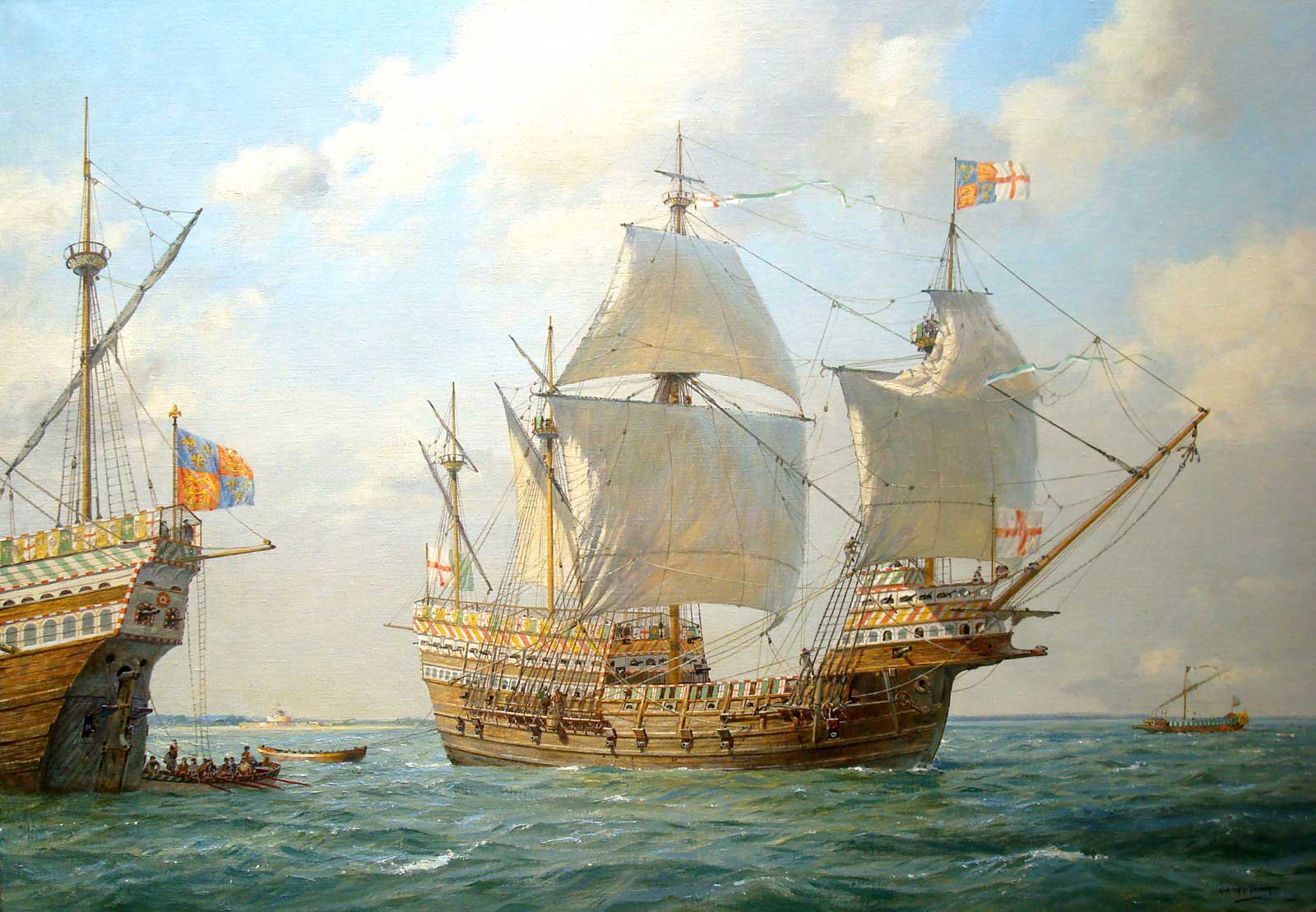
Shortly afterwards, the fleet set off from Southampton. Lord Thomas Howard, now the Earl of Surrey, decided to use the Mary Rose as his flagship; the superior sailing of the Mary Rose trumped the size of the Great Harry. Surrey successfully attacked the Breton port of Morlaix on 1st July 1522 but the supplies that he requested in order to take Brest never arrived. He had no choice but to return to Portsmouth. The Admiral was redeployed and given command of a land force at Calais at this point; the Vice-Admiral, Sir William Fitzwilliam, also chose the Mary Rose to be his flagship. The Mary Rose had now been the preferred ship of Sir Edward Howard, Lord Thomas Howard and Sir William Fitzwilliam.
The second war with France was mostly a collection of skirmishes, with very little actually happening until 1525 and the Battle of Pavia, which ended the war. The English, however, had nothing to do with Pavia, which saw King Francis captured by Spanish forces. The fleet does not seem to have been mobilised at all throughout 1525 and the Mary Rose was moved to Deptford that summer to be recaulked.
 |
|
| Back to top |
|
|
Salty Dog
Sailing Master
Posts: 10063
192187 Gold -
more...
|
| Posted: Sun May 03, 2020 5:51 pm Post subject: |
|
|
The Mary Rose was largely inactive for the first five years of the 1530s.
From January 1536 to March 1537, the Mary Rose could be seen in the Thames without her masts. As tensions mounted in Europe as a result of Henry’s break from the Church of Rome, Henry began reinforcing his warships and the Mary Rose underwent a refit. Extra gunports were added and the sides of the ship were strengthened in order to accommodate the extra weight.
Unfortunately, the new alterations to the Mary Rose may have cost her her impressive sailing. In April 1537, Vice-Admiral John Dudley reportedly that some of the ships were “unweatherly” and that “the ship that Mr Carew is in” was particularly bad. While it’s not clear which ship “Mr Carew” was on, George Carew was the captain of the Mary Rose when she sank eight years later; it is not impossible that the problematic ship was the Mary Rose.
In 1539, Henry mobilized the fleet once more, in fear of a joint invasion from France and Spain. Henry had been excommunicated by the Pope for declaring himself Head of the Church of England and he feared the Catholic powers of Europe would attack. In the summer of 1539, the Mary Rose was anchored at Deptford, ready to defend the Thames.
 |
|
| Back to top |
|
|
Salty Dog
Sailing Master
Posts: 10063
192187 Gold -
more...
|
| Posted: Sun May 03, 2020 5:54 pm Post subject: |
|
|
Henry’s fears of a combined Franco-Spanish invasion came to nothing as the treaty between Francis and Charles fell apart by 1539. However, Henry’s fleet remained prepared throughout the campaigning months of 1539-1542.
In June 1542, Henry entered an alliance with Charles of Spain against Francis, thus beginning Henry’s last war with France. The reasons for Henry entering this war are unclear, although it is worth noting that his fifth wife, Catherine Howard, had been found guilty of adultery and executed just four months previously; perhaps Henry was desperate to prove his power and masculinity in the face of this humiliation.
It is not known whether or not the Mary Rose was part of the fleet that took Henry himself to Calais in 1544, although it is likely, since most of the fleet was involved. In September 1544, Henry captured the French town of Boulogne. However, his alliance with Charles of Spain fell apart and England was left isolated against France.
The French retaliation for Boulogne was to prove fatal for the Mary Rose.
July 1545: The Battle of the Solent and the sinking of the Mary Rose
Claude d’Annebault, the French Admiral, gathered over 200 ships in the estuary of the River Seine. This fleet was significantly larger than the Spanish Armada nearly 50 years later, which totalled 130 ships. Against this number, the English amassed around 80 ships.
John Dudley, Viscount Lisle, was Lord Admiral of the Fleet and he did not intend to sit wait for the French attack. Lisle sent fireships in amongst the anchored French fleet at Le Havre to burn the French ships; the French flagship, the 100-gun Philippe, burned. Ominously for the French, the next ship chosen to hoist the Admiral’s flag then ran aground and had to be abandoned.
On the 12th July 1545, the French set sail, reaching the Sussex coast on the 18th. After an insignificant raid in Sussex, the French fleet entered the Solent on the 19th July.
The night before (18th July 1545), King Henry VIII dined aboard his flagship, the Great Harry, with Viscount Lisle and Sir George Carew, where Carew was appointed Vice-Admiral of the Fleet and given command of the Mary Rose.
 |
|
| Back to top |
|
|
Salty Dog
Sailing Master
Posts: 10063
192187 Gold -
more...
|
| Posted: Sun May 03, 2020 5:55 pm Post subject: |
|
|
The loss of the Mary Rose
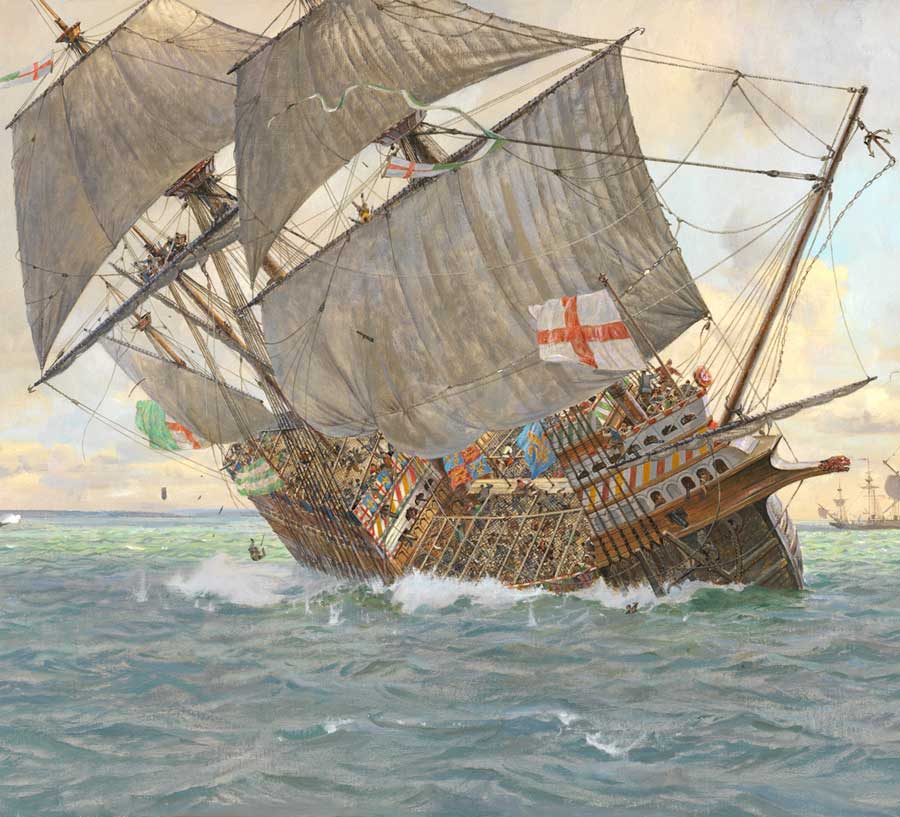
When the French fleet arrived, Henry watched from Southsea Castle. The lack of wind gave the French the advantage, the oared French galleys able to advance while the large sailing ships were immobile. Towards the afternoon, however, the wind rose and Lisle led out his large ships, including the Mary Rose.
The Mary Rose fired from her starboard side, then came about to fire from the port side. As she turned, she listed to one side, her starboard side low in the water. The Spanish Ambassador Francois van der Delft, an eyewitness to the battle, wrote that the ship “heeled over with the wind”. The starboard gunports were, crucially, left open, and, with the final nudge from the wind, they fatally dipped below the waterline. The water flooded in and the ship went down in a matter of minutes. Of the nearly 500 men on board, no more than 35 survived.
Despite the tragedy of losing the Mary Rose, she was the only loss of the battle. The two fleets sat in a deadlock in the Solent, a situation that favoured the English, who only needed to hold the port and who had supplies and reinforcements. On the 23rd July 1545, d’Annebault made the decision to retreat.
 |
|
| Back to top |
|
|
Salty Dog
Sailing Master
Posts: 10063
192187 Gold -
more...
|
| Posted: Sun May 03, 2020 5:57 pm Post subject: |
|
|
Raising the Mary Rose: the Tudor attempts
After the battle, it was believed that it would be relatively easy to raise the Mary Rose. Divers were sent down to attach cables to the masts of the sunken ship; these cables were then attached to two ships that would sail away from one another. The resulting tension would then, theoretically, bring the Mary Rose to the surface.
On Saturday 1st August, Charles Brandon, Duke of Suffolk wrote that “I trust by Monday or Tuesday, at the furthest, that the Mary Rose shall be weighed up and saved”. Unfortunately, this confidence was unfounded. The masts broke during the raising attempt and all further attempts to raise her in the following weeks failed.

Raising the Mary Rose: the 19th Century attempts
In 1836, pioneering divers John and Charles Deane were exploring wrecks in the Solent, notably the 1782 warship, the Royal George. While they were exploring, some fishermen requested their assistance; their nets kept getting caught in a particular area and they asked the divers to explore. The Mary Rose was rediscovered after nearly 300 years.
The Deane brothers recovered several large guns from the ship, attracting a large amount of attention. After a while, however, excitement over the discovery faded. It was the practice at the time to detonate shipwrecks lest they cause problems for modern ships; luckily the Mary Rose barely protruded above the seabed and so she was saved from this fate. However, it was largely believed that she had in fact been destroyed and, as interest in the wreck died, the Mary Rose was lost once more.
 |
|
| Back to top |
|
|
Salty Dog
Sailing Master
Posts: 10063
192187 Gold -
more...
|
| Posted: Sun May 03, 2020 6:04 pm Post subject: |
|
|
Raising the Mary Rose
After 437 years, Mary Rose was finally returned to the surface in a maritime salvage operation seen by over 60 million people across the world.
But how was it made possible?
Recovering the Mary Rose
A huge team of divers, archaeologists and scientists was involved in raising the Mary Rose.
Amateurs and professionals alike were dedicated to the cause, and the project broke new ground in diving and conservation techniques.
The search: 1965 – 1970
The search for and discovery of the Mary Rose was a result of the dedication of one man, the late Alexander McKee. In 1965 in conjunction with the Southsea branch of the British Sub-Aqua Club, McKee initiated ‘Project Solent Ships’ to investigate wrecks in the Solent. His real hope was to find the Mary Rose.
By using sonar scans, the team discovered a strange shape underneath the seabed. Alexander strongly suspected he had found his quest. Between 1968 and 1971, a team of volunteer divers explored the area. Using dredgers, water jets and airlifts, they began to excavate and were encouraged by the appearance of stray pieces of timber.
The climax came when diver Percy Ackland found three of the port frames of the Mary Rose on the 5th May 1971.
The early years: 1971 - 1978
Frames, planking and deck beams were seen by divers at the wreck, and a series of limited excavations outside the ship were carried out to find out how much might have survived.
In 1978 a trench across the wreck at the bow proved that two decks survived in situ at this point. The team decided to excavate the ship in its entirety, and formed the Mary Rose Trust in 1979 with H.R.H. The Prince of Wales as president. Full-time staff were appointed to carry out the work of excavating the ship and her contents.
Over 500 volunteer divers, and many more volunteers on shore, helped with the work.
The excavation: 1979 – 1982
In March 1979 the salvage vessel Sleipner was moored on site. This large vessel meant that divers and finds staff could work in shifts, accelerating the diving programme. The project became a professional one, with full-time archaeologists, finds staff, administrators, conservators and fundraisers.
Divers carefully used trowels and airlifts, gently wafting silt away from delicate artefacts with their hands. The site was divided up using a grid of bright yellow pipe, so divers could find their exact position. All artefacts and timbers found were carefully surveyed and recorded.
When brought to the surface, artefacts were stored in a controlled environment. Complete chests were brought up intact so they could be excavated in carefully controlled conditions
The raising of the Mary Rose: 1982
A committee was set up to consider many different methods of raising the hull. They decided to use a purpose-built lifting frame that would be attached by wires to steel bolts passing through the hull at carefully selected points. These points were spread evenly across the section of the ship, mainly in the major structural beams.
The tubular steel lifting frame was placed in position and supported on four legs above the wreck. The hull was wired to the frame from the bolts. Hydraulic jacks then raised the hull a few critical centimetres to lift it from the suction effect of the silt below.
Hanging from the frame, the hull could now be transferred into a steel cradle that was in place on the seabed to the west of the wreck. When the weather and tide were favourable, the lifting frame was raised by the crane Tog Mor, and the hull was moved above the cradle. |
|
| Back to top |
|
|
|
|
You cannot post new topics in this forum
You cannot reply to topics in this forum
You cannot edit your posts in this forum
You cannot delete your posts in this forum
You cannot vote in polls in this forum
|
Powered by phpBB © 2001, 2005 phpBB Group |
|